
Treatment for the water you make and the water you carry.
Two treatments: one keeps your evaporator free of scale and carry-over, the other stops mud and silt packing down in the ballast tanks.
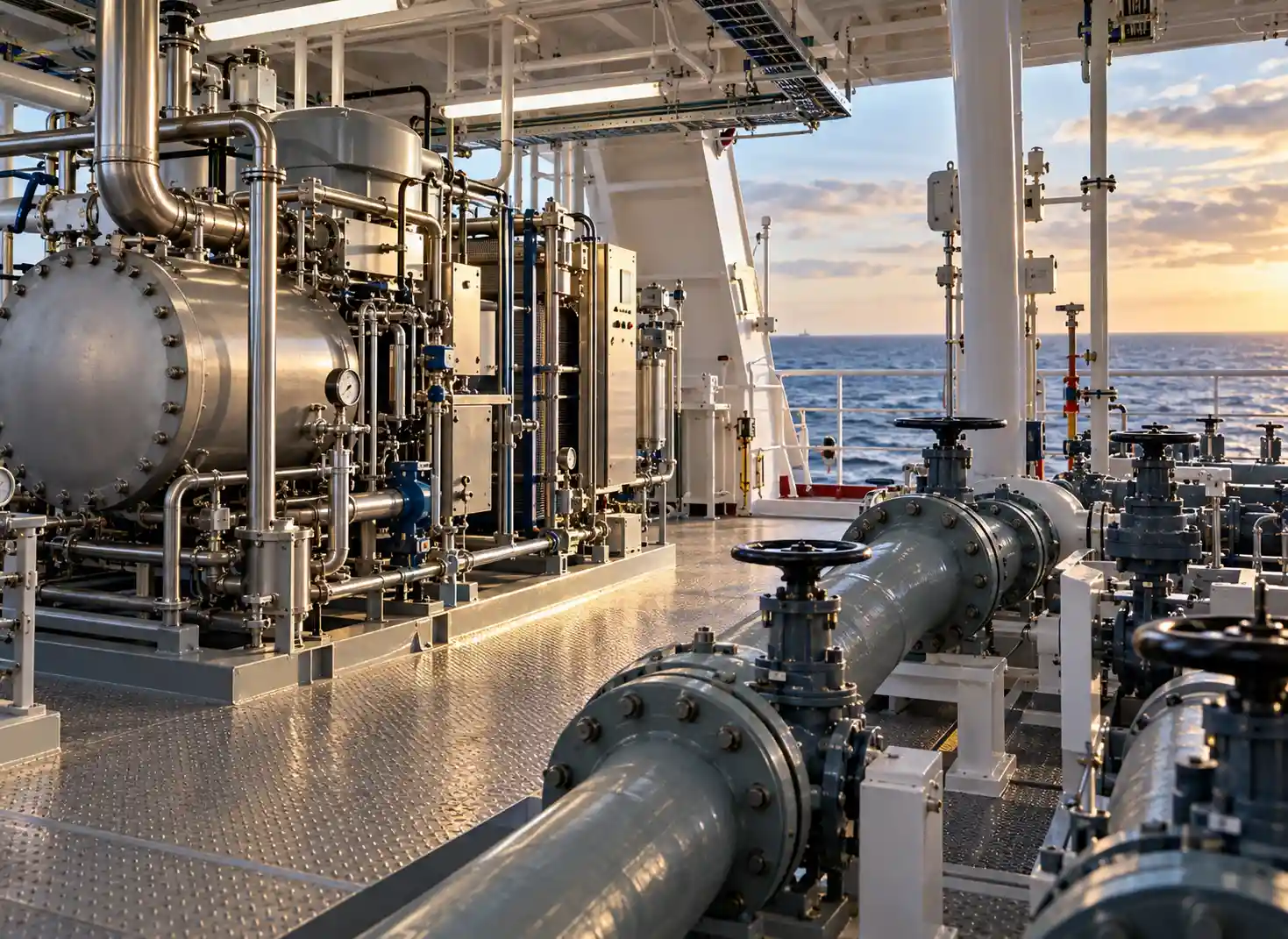
What are you treating?
Why it matters
Both problems start with something that settles.
Scale settles on the tubes of a fresh-water generator. Mud and silt settle on the floor of a ballast tank. Stop either one early and you avoid acid descaling and hard-packed tank cleaning.

Scale
Hardness in the seawater feed deposits on the heat transfer surfaces and cuts distillate output.

Carry-over
Foaming brine carries salt over into the distillate and lowers its purity.

Sediment
Seawater, river and harbour water drop solids that settle and compact on the tank floor.

Lost capacity
Hard-packed sediment takes up ballast capacity and makes every tank cleaning slower.
Sheran manufactures both treatments at its own plants in Fujairah and Athens.
The range
Two treatments. One for the evaporator, one for the ballast tanks.
Showing 2 of 2
Evaporators
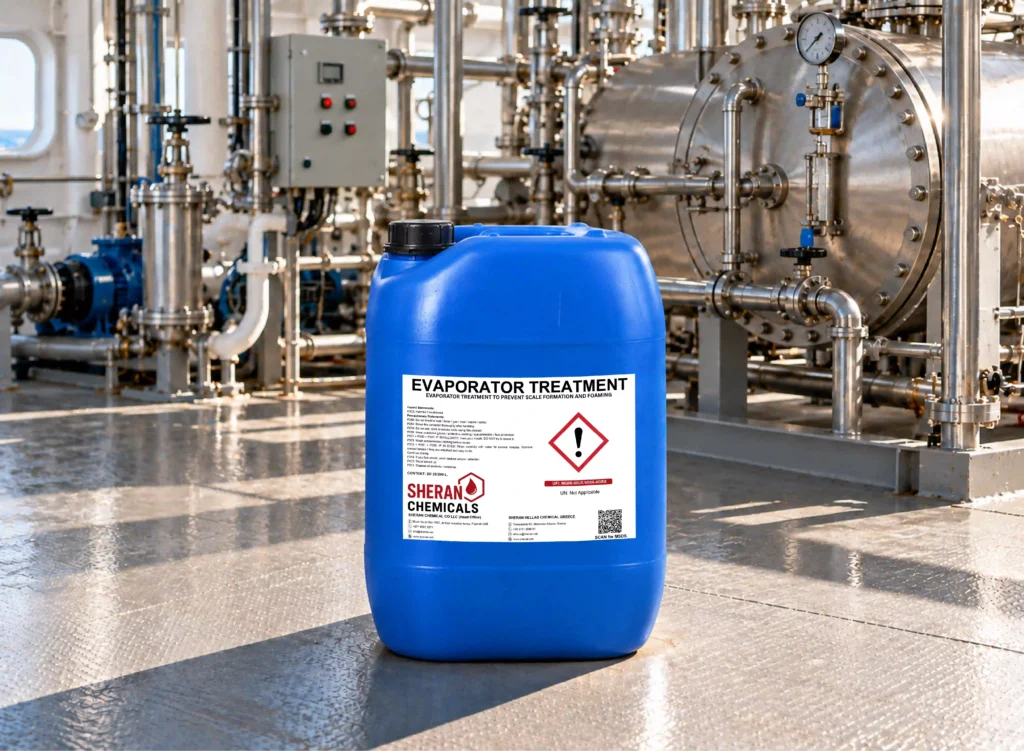
Evaporator Treatment
Scale and foam control for marine fresh-water generators. Keeps heat transfer surfaces clean and the distillate pure, on vacuum and high-pressure evaporators.
Dose
25 mL per tonne of distillate, dosed continuously
Ballast tanks
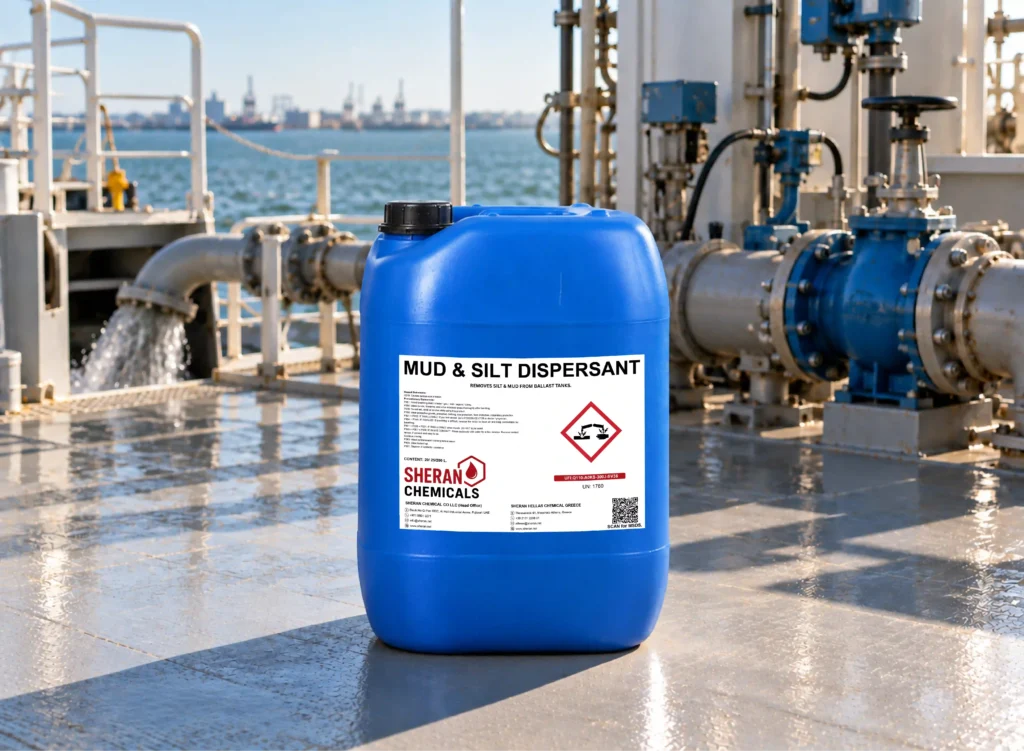
Mud & Silt Dispersant
Ballast tank sediment conditioner. Keeps mud and silt in suspension so it leaves with the ballast water instead of packing down on the tank floor.
Dose
0.5 L per 10 t of ballast water, added before ballasting
Looking for a safety data sheet?
Material safety data sheets are issued on request, for any product in this range.
Dose guide
Dose by output. Clear old mud by procedure.
Size the evaporator dose from daily distillate output. For mud already in a ballast tank, run the lifting procedure once before routine dosing.
Evaporator Treatment
| Distillate output | Treatment per day |
|---|---|
| 10 MT/day | 250 mL |
| 20 MT/day | 500 mL |
| 40 MT/day | 1.0 L |
| 60 MT/day | 1.5 L |
| 100 MT/day | 2.5 L |
| Operating limit | Maximum |
|---|---|
| Brine density | 1.5/32 |
| Specific gravity | 1.038 g/cm³ |
Mud & Silt Dispersant
| Step | Mud lifting, existing sediment |
|---|---|
| 01 | Dose 1 L per 10 t of tank capacity. |
| 02 | Fill the tank to about 50% with seawater. |
| 03 | Let vessel movement circulate it for about 24 hours. |
| 04 | Fill the tank to capacity and pump out. |
| 05 | Refill and discharge again before inspection. |
| Routine | Before every ballasting |
|---|---|
| Dose | 0.5 L per 10 t of ballast water |
| Adjust | Up or down with sediment load at the ballast source |
Common questions
Evaporators, brine and ballast sediment.
All vacuum and high-pressure evaporators. Dose Evaporator Treatment continuously into the feedwater line, or directly into the evaporator shell through a dosing system.
Keep brine density at or below 1.5/32, a specific gravity of 1.038 g/cm³. Dose continuously, not in batches.
Yes. Remove existing scale before you start treatment. Evaporator Treatment then keeps the heat transfer surfaces clean and cuts the need for acid descaling.
Dose 1 L of Mud & Silt Dispersant per 10 t of tank capacity and fill the tank to about half with seawater. Let the vessel’s movement circulate it for about 24 hours, then fill to capacity and pump out. Refill and discharge once more before inspection.
Yes. Add 1 L of Mud & Silt Dispersant per 1,000 L of oily water, mix thoroughly and let it stand for 4 to 6 hours for the oil and water to separate.
Evaporator Treatment comes in 25 L HDPE cans. Mud & Silt Dispersant comes in 25 L HDPE cans and 200 L HDPE drums. Both keep for 24 months in the sealed original container.
Order
Tell us the output and the tanks, we will size the order.
Send the evaporator’s daily distillate output, whether it runs under vacuum or high pressure, and your total ballast capacity. We will come back with dosing and quantities.
Two production units
Fujairah and Athens
Certified
ISO 9001:2015
Trade Net ID
ShipServ TN-315946
Partner ID
ProcureShip PS ID 14754
