
Cooling water treatment for both sides of the cooler.
Three treatments: an inhibitor and an antifreeze for the closed fresh-water circuit, and an antifoulant for the seawater side. Formulated and batch-tested in our own plants in Fujairah and Athens.
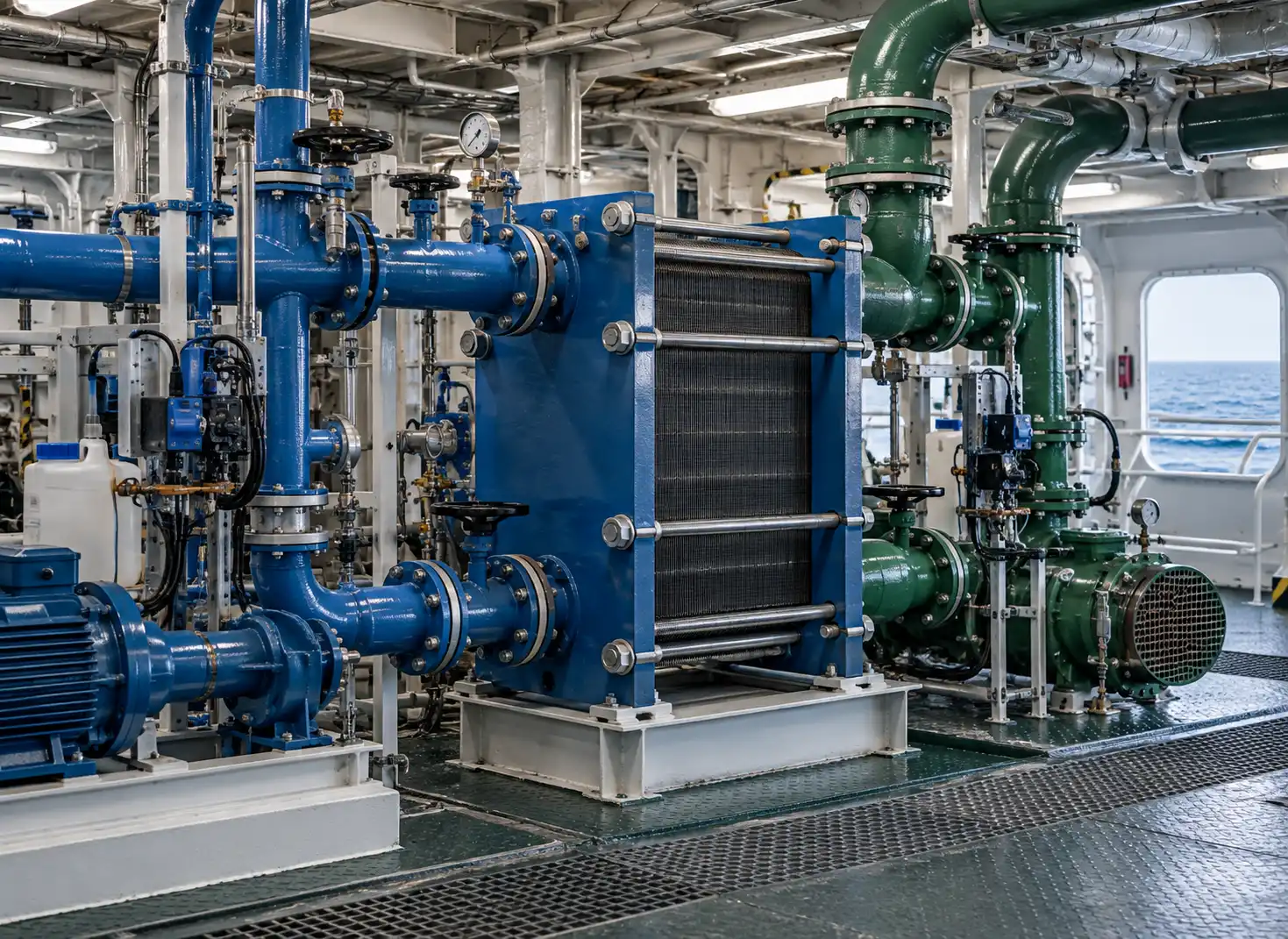
What are you treating?
Why it matters
One number keeps a closed loop safe: nitrite.
Hold the nitrite reserve between 1,200 and 1,500 ppm and the closed circuit is protected. Below 1,000 ppm protection is already slipping, and below 500 ppm the treatment has to be re-established. Test the reserve regularly and top up to the level, not by the calendar.

Corrosion
Untreated jacket water attacks steel, copper and aluminium, and galvanic pairs make it worse.

Scale
Shore or potable water brings hardness into the loop, and it settles where the heat transfer happens.

Cavitation
Collapsing vapour bubbles pit cylinder liners and pump impellers on the coolant side.

Marine growth
Barnacles, shellfish and slime settle in sea chests and strainers and choke seawater flow to the cooler.
Sheran manufactures three cooling water treatments at its own plants in Fujairah and Athens.
The range
Three treatments. Two for the closed loop, one for seawater.
Showing 3 of 3
Closed fresh-water circuit
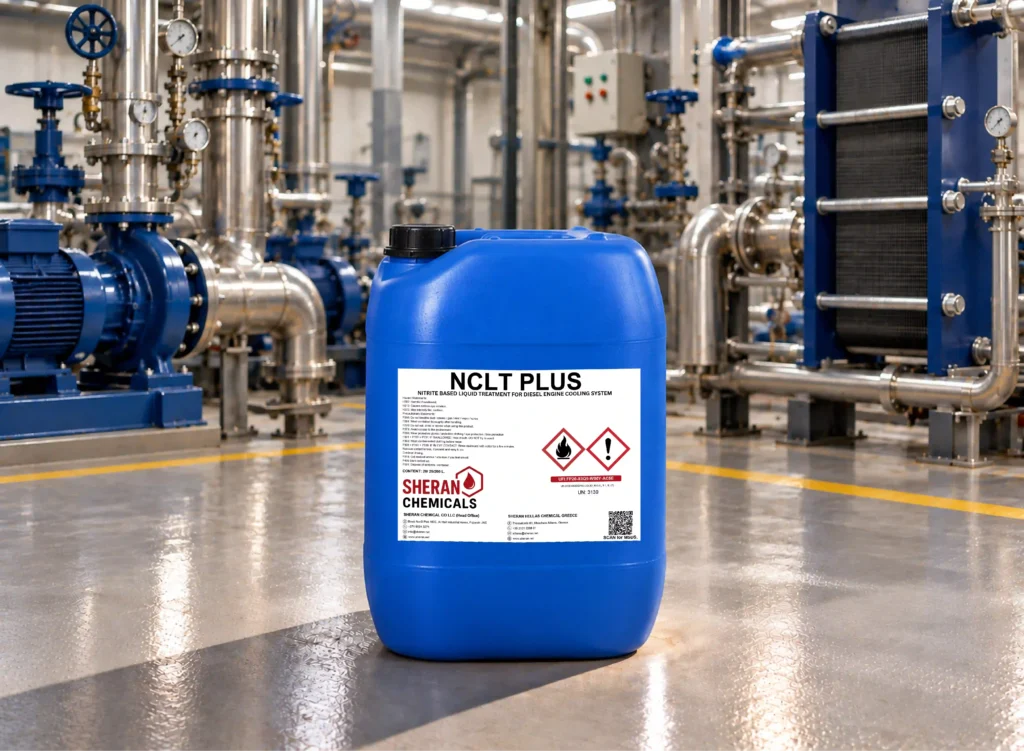
NCLT Plus
Nitrite-borate inhibitor for closed cooling. Corrosion, scale and cavitation control in one treatment
Dose
10.3 L per tonne of system water, then hold nitrite at 1,200 to 1,500 ppm
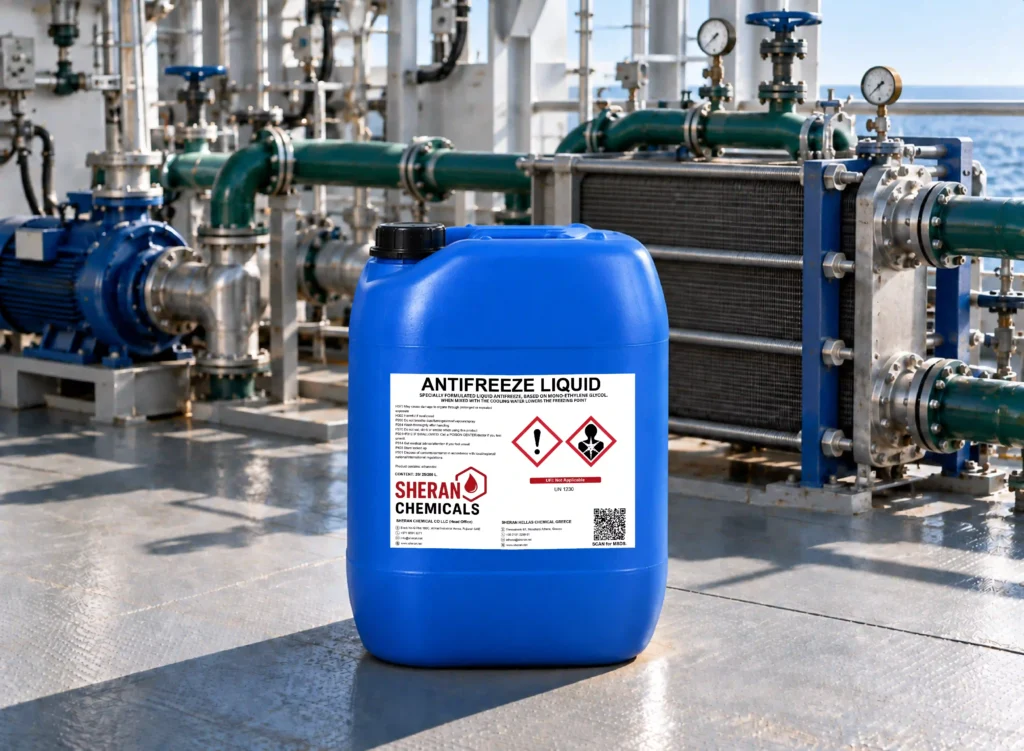
Antifreeze Liquid
Mono-ethylene glycol coolant. Freeze protection to −40°C, safe on aluminium, hoses and seals
Dose
1 part to 3 of water for −5°C, used neat for −40°C
Open seawater side
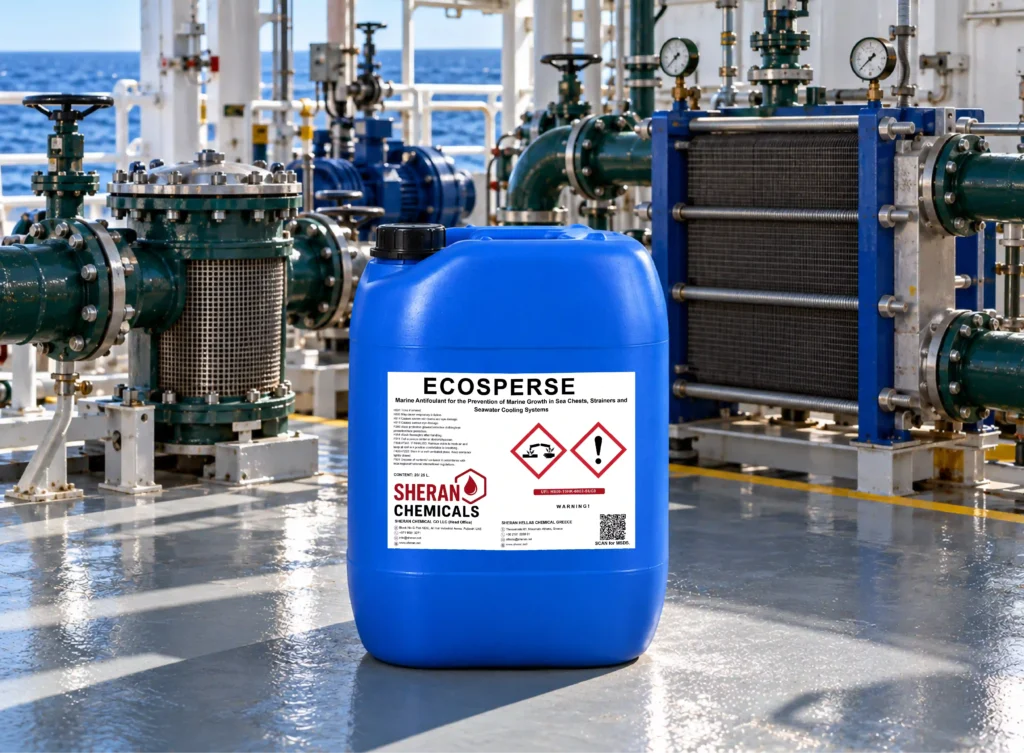
Ecosperse
Amine antifoulant. Keeps barnacles, shellfish, algae and slime out of sea chests, strainers and coolers
Dose
0.3 L per 100 t/h of seawater flow, over 1 h every 48 h
Looking for a safety data sheet?
Material safety data sheets are issued on request, for any product in this range.
Where it acts
Both sides of the cooling system.
From the sea chest to the engine jackets, each treatment works at a different point. Dose where the problem is.
Where seawater enters. Barnacles, shellfish and slime settle here first.
Ecosperse
Strainers, filter boxes and pipework. Growth restricts the flow.
Ecosperse
Where both sides meet. Fouling on the sea side, corrosion on the fresh.
Ecosperse
NCLT Plus
Pumps and pipework. Dose where circulation is strongest.
NCLT Plus
Antifreeze Liquid
Liners, heads and light alloys. Corrosion, cavitation and freezing.
NCLT Plus
Antifreeze Liquid
Suitable for main and auxiliary engine closed cooling circuits, central coolers and seawater cooling systems, on deep-sea and coastal vessels.
Common questions
Nitrite, make-up water and dosing.
Between 1,200 and 1,500 ppm. At 1,000 to 1,200 ppm add 1.5 L of NCLT Plus per tonne of system water, at 800 to 1,000 ppm add 3 L, and at 500 to 800 ppm add 5 L. Below 500 ppm, treat the system again from the start.
No. Shore and potable water carry dissolved minerals that feed scale and corrosion. Fill and top up with demineralised, RO or evaporator water only.
Yes. NCLT Plus is compatible with all glycol-based antifreeze, including our Antifreeze Liquid. Use the two together where the circuit needs freeze protection as well as corrosion control.
Deep-sea vessels: 0.3 L per 100 t/h of seawater flow, injected into the sea chest over one hour every 48 hours. Coastal vessels: the same rate spread over 24 hours. In harbours with heavy growth, dose more often.
Yes. A closed circuit carrying oil, sludge or scale should be cleaned before NCLT Plus goes in, and a seawater system with existing growth should be descaled before Ecosperse.
NCLT Plus and Ecosperse come in 25 L HDPE containers. Antifreeze Liquid comes in 25 L cans and 200 L drums.
Order
Tell us the engine, we will tell you the programme.
Send the system volume, your last nitrite reading and the seawater flow rate. We will come back with a dosing programme and a price, usually within one working day.
Two production units
Fujairah and Athens
Certified
ISO 9001:2015
Trade Net ID
ShipServ TN-315946
Partner ID
ProcureShip PS ID 14754
